
Projects
Microstructure-based prediction of micromechanical properties using machine learning methods
Status: running
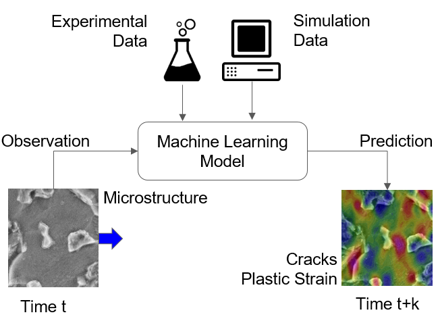
In this PhD project, we are investigating the use of machine learning to predict material properties. Rather than predicting a single global parameter, we are focusing on predicting a locally resolved parameter mapping. To achieve this, we are investigating image-to-image translation models that can predict property mappings directly from microstructure images. This approach is based on cross-scale microstructure characterization, the generation of experimental data through ex-situ and in-situ mechanical tests, and simulation-to-experiment pretraining to enrich the experimental data.
Workers: Jan Niklas Kaufmann
Data-frugal methods for machine learning based microstructure analysis
Status: running
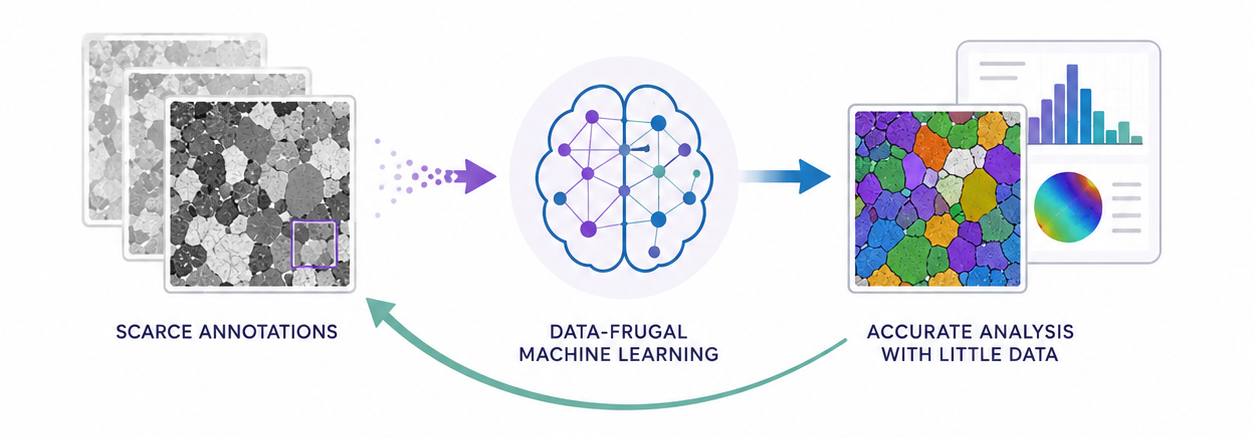
The diversity and complexity of materials and microstructures means that annotations for training a model are costly and time-consuming, and thus scarce. In order to establish ML-based microstructure analysis as a tool for large-scale data collection, we must be able to quickly and flexibly train good models for new questions, even with a small database. In this project, we focus data-frugal methods for machine learning based microstructure analysis. We will explore, among others:
- Active learning and semi-supervised learning
- Synthetic data generation
- Generative models for data augmentation
- Self-supervised learning
- Adaption of cross-domain foundation models
Workers: Camilo Andres Martinez Martinez

Agentic AI for Metallography
Status: running
Can agentic AI also be used for questions and applications in metallography that are usually very domain-specific and cannot always be reliably answered by a standard LLM? That is exactly what we are examining in this project. The foundation for this consists of structured databases containing text-based knowledge, images, and preparation recipes. We are currently building these databases and using LLMs for literature mining and annotation to convert various data sources into uniform structures.
Workers: Hurriya Nasir, Noah Quartz
AI based Microstructure Analysis in a Low Data Regime (Master Thesis)
Status: running
In this thesis, we investigate whether we can reduce the annotation effort for ML model training by automatically selecting a subset of images that are representative of the entire dataset while simultaneously maximizing diversity within the subset. Key for optimizing such a workflow is a systemic study of the feature space and representativeness measures we use for selecting the subset. The thesis is co-supervised with the Chair of Functional Materials at Saarland University.
Workers: Benjamin Arias
Exploring the Segment Anything Model for Microstructural Image Segmentation (Bachelor Thesis)
Status: starting 08/2026
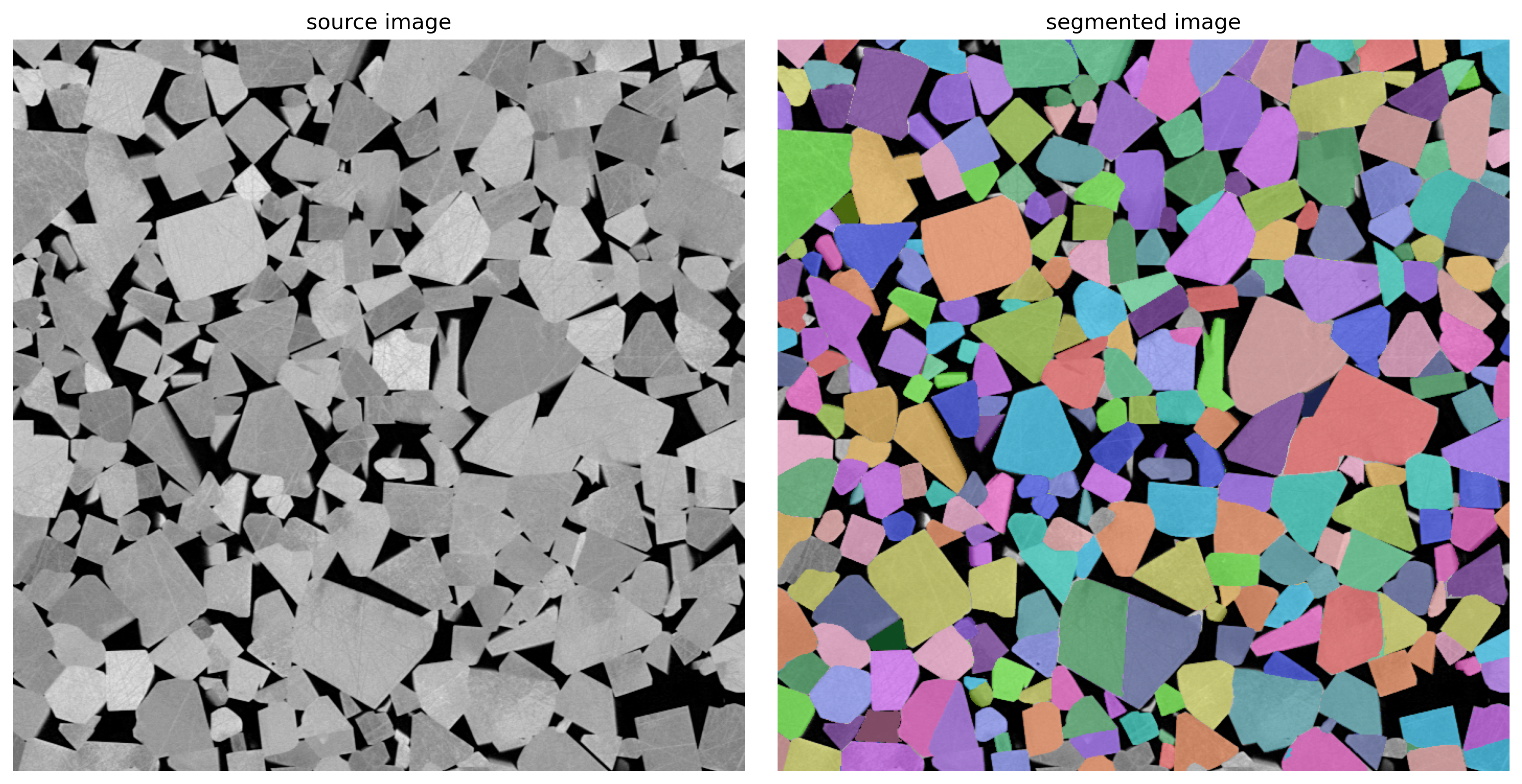
In this bachelor thesis, we explore how well the Meta Segment Anything Model (SAM) segments microstructural features out of the box, and to what extent prompting strategies, model size selection, and pre/post-processing routines, as well as domain-specific fine-tuning, can close the gap to fully supervised segmentation.
Workers: Julian Fisselbrand
Deep Learning Approaches for Multimodal Image Registration in Microscopy (Master Thesis)
Status: starting 08/2026
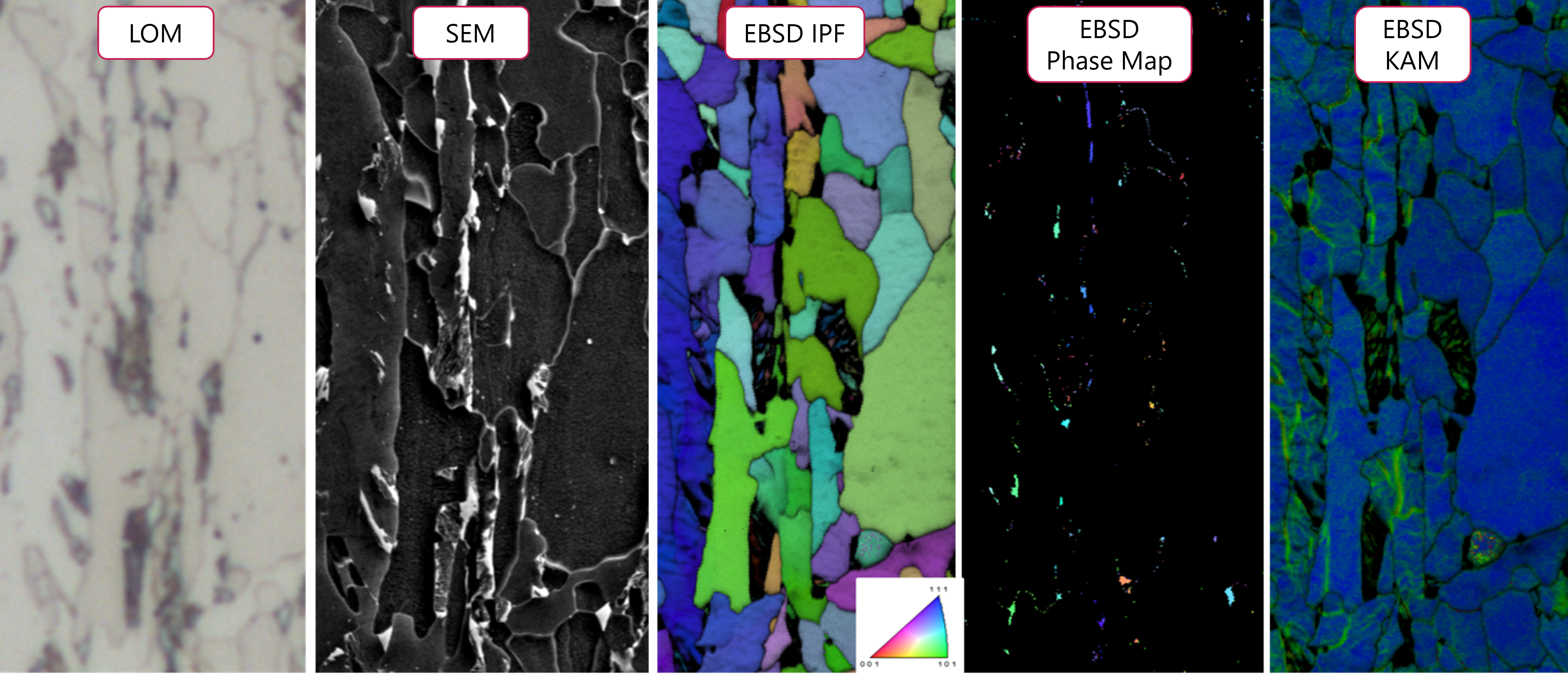
In Materials Science, correlative microscopy is used in microstructure analysis to combine complementary information from different imaging modalities, such as structural, chemical, and topographical features, into a more comprehensive understanding of the material. A critical step in correlative microscopy is accurate image registration. Currently, this is performed using feature-based pipelines combining SIFT feature extraction with non-rigid alignment tools such as bUnwarpJ. This thesis project aims to investigate deep learning–based alternatives to overcome the limitations of SIFT feature extraction and enable a more robust and automated multimodal image registration.
Workers: Karnika Bhardwaj
Data-driven and microstructure-informed optimization of spark plasma sintering processes (Master Thesis)
Status: running
This thesis, which we are co-supervising and which is primarily being carried out at Montan University Leoben, aims to optimize spark plasma sintering processes for ceramics. During her exchange stay at our group, Mahima Haque is using machine learning models for the quantification of grain sizes and porosities. The results are then used in a bayesian optimization framework for inverse process design and guided experimentation.
Workers: Mahima Haque